Advertisement
I Made a Self-Aware Robot


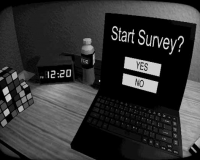
I Made a Self-Aware Robot is an interactive narrative built around a fixed sequence of exchanges between a human operator and a machine. The experience removes conventional gameplay systems and replaces them with structured observation. There are no explorable spaces, challenges, or branching outcomes. Progress occurs as interactions advance in order, allowing the player to track how the robot’s behavior changes over time through language, timing, and response patterns.
Framework and Intent
The structure establishes a clear framework from the beginning: a completed robot, an operator, and a controlled setting. Early exchanges present the robot as a functional system responding to prompts. The environment remains static, keeping attention on communication rather than action. The intent is not to simulate autonomy mechanically, but to present a scenario where perceived awareness is communicated through dialogue and pacing rather than systems or rules.
Interaction Pace and Observation
Interaction is intentionally minimal and repetitive. The player advances the sequence, then waits for the robot’s response. This rhythm places emphasis on small variations rather than dramatic shifts. Changes are not announced; they must be noticed. The lack of interruption allows patterns to form, making it possible to compare earlier responses with later ones and infer development without explicit confirmation.
At the midpoint of the experience, the player consistently encounters:
- repeated prompts with altered responses
- pauses that change interaction tempo
- references to physical form and limitation
- adjustments in how the robot addresses itself
- transitions that mark new stages without explanation
Communication and Sensory Signals
Audio carries most of the information. Subtle changes in delivery, spacing between lines, and silence function as signals of internal change. Visual presentation remains restrained, preventing distraction from the exchange itself. There are no interface elements indicating objectives or progress, so understanding depends on attention to communication cues rather than metrics.
The player’s position remains observational throughout. Inputs do not influence direction or outcome, reinforcing a sense of distance from control. This limitation is deliberate, framing the experience as something unfolding rather than something to be managed. The absence of choice shifts responsibility from decision-making to interpretation, asking the player to consider meaning rather than consequence.






























































Advertisement