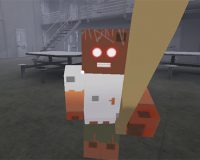
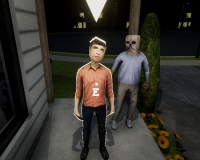
IT – The Game is a third-person horror experience built around restricted movement and gradual exposure to danger. From the opening sequence, the player is placed in an enclosed underground setting where forward movement feels uncertain and visibility is limited. The game avoids direct explanations and does not provide constant guidance, forcing attention toward space, sound, and timing. Progress is achieved by moving deeper into the environment rather than completing explicit objectives.
Spatial Layout And Camera Use
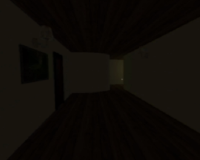
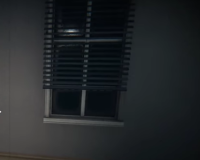
The camera is positioned behind the character, limiting the player’s view and reinforcing a sense of vulnerability. Corridors, tunnels, and chambers are narrow and repetitive, which makes orientation difficult and encourages slow movement. Lighting is uneven and often minimal, obscuring distant details and reducing the ability to anticipate what lies ahead. The layout is mostly linear, but the lack of visual landmarks causes spaces to blend together, increasing tension through uncertainty.
Interaction And Gameplay Constraints
Interaction in IT – The Game is deliberately minimal. The player cannot fight, collect items, or manage systems, and there are no tools available to influence the environment directly. Gameplay is focused on walking, stopping, and observing. This limitation removes the option of control through action and instead emphasizes awareness. Moments of danger are brief and disruptive, breaking the rhythm of exploration without becoming constant obstacles.
During progression, the player repeatedly relies on a small set of core actions:
- moving through confined underground spaces
- observing visual changes in the environment
- reacting to sudden appearances or sounds
- maintaining direction without on-screen guidance
These actions form the entire gameplay loop.
Audio Design And Psychological Pressure
Sound design plays a critical role in shaping player behavior. Ambient noise, echoes, and distant footsteps provide indirect information about surroundings. Silence is used to create pauses where expectation builds without resolution. Audio cues do not always lead to immediate events, preventing predictable responses and keeping the player alert. This approach turns sound into a source of uncertainty rather than clear instruction.
The interface is kept almost entirely free of visual elements. There are no objective markers, meters, or constant indicators. Feedback is delivered through environmental changes, character movement, and audio shifts. This design choice ensures that attention remains fixed on the world itself rather than on the screen layout.






























































Advertisement